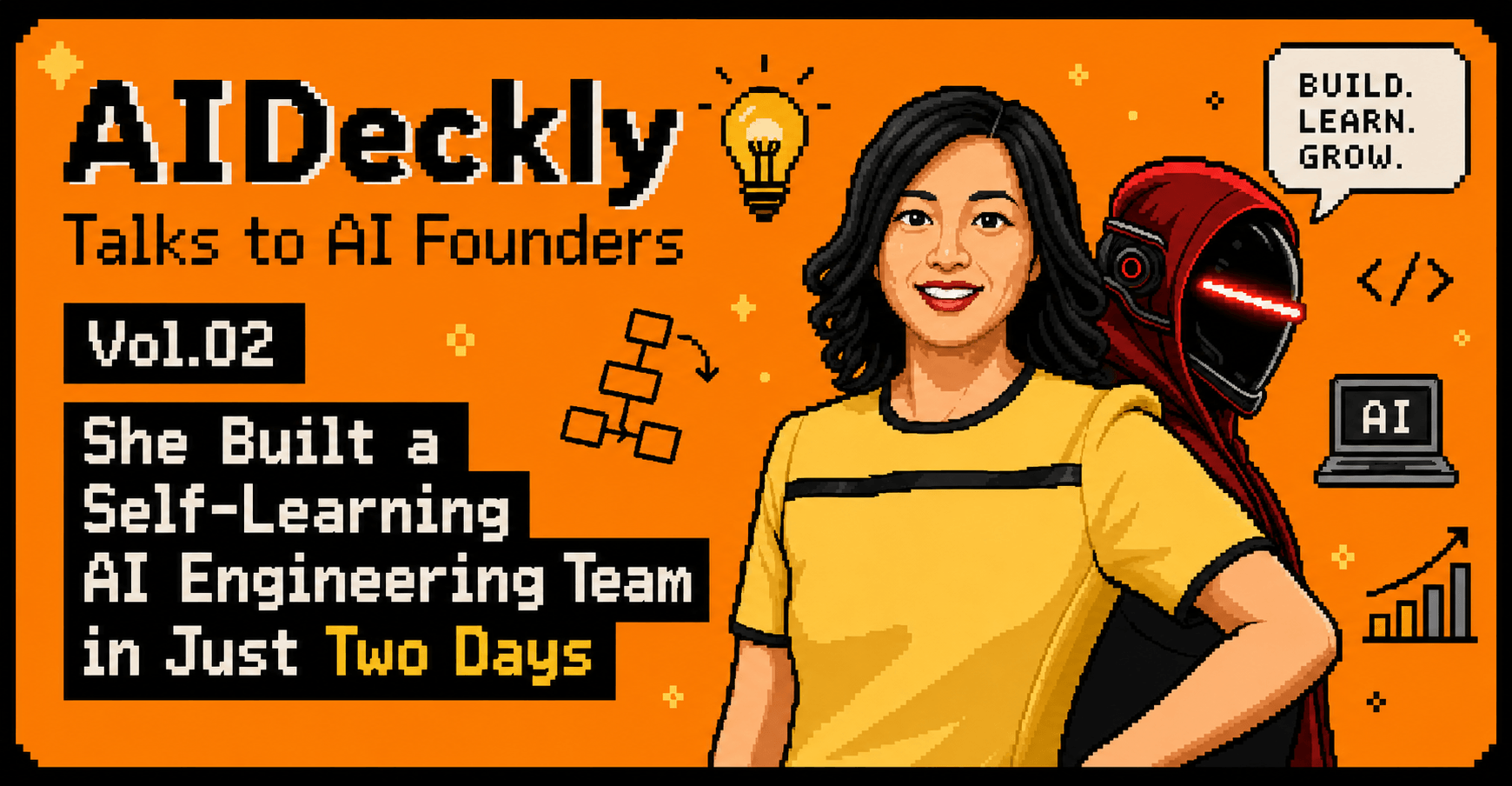
She Built a Self-Learning AI Engineering Team in Just Two Days
Q Zhao
Founder of 2RedBeans · Building Webreeze AI
Exploring AI Agents, Autonomous Organizations, and the Future of Human Relationships
AIDeckly Talks to AI Founders | Vol.02#
She Built a Self-Learning AI Engineering Team in Just Two Days#
AI is transforming software development at an unprecedented pace. From code-completion tools to autonomous agents capable of executing complex tasks, and now to collaborative AI teams, a new generation of builders is redefining what it means to be a developer. In this edition of AIDeckly Talks to AI Founders, we speak with a female AI founder who recently built a self-learning AI engineering team. We discuss:
- Her journey from a single agent to a multi-agent organization
- The future of work in the AI era
- Building in Public
- How AI may reshape human relationships
- Staying focused in a rapidly changing industry
From a Single Agent to an AI Engineering Team#
AIDeckly#
How did you come up with the idea of building an AI engineering team?
@qzhao27#
Honestly, there wasn't a single lightbulb moment. I was watching people on YouTube demonstrate AI agents that could handle entire engineering workflows and even submit merge requests automatically. Around the same time, Anthropic's work on the Ralph Loop inspired me to experiment with my own agent framework. I started by building a simple agent loop. At first, it wasn't particularly impressive. But as models improved and the underlying infrastructure became more reliable, the system improved as well. For a long time, it was just one agent working through my development tickets one at a time. Then about a week ago, I had a new thought:
If one agent can work effectively, why can't an entire engineering team? So I spent two intense days building exactly that.
Today, the structure is surprisingly simple:
- I define the product requirements.
- A Sprint Lead Agent breaks them into manageable tasks.
- Multiple Engineering Agents execute the work.
- Results are delivered back through a unified workflow.
The process feels remarkably similar to how a real software team operates. What I'm most proud of, however, is the learning system behind it. While the team is working, a dedicated Learning Loop continuously analyzes:
- Logs
- Errors
- Execution results
Whenever it discovers a problem, it investigates the root cause and improves the process automatically. As a result, every task makes the system slightly smarter than before. That's what excites me most about AI agents.
They're not just capable of working. They're capable of growing.
The Most Important Skill in the AI Era#
AIDeckly#
What do you believe is the most valuable skill in a world increasingly shaped by AI?
@qzhao27#
Boris from Anthropic once said:
"Coding is already a 100% solved problem." I think there's a lot of truth in that. It's similar to how people no longer need to make their own clothes. The production process becomes automated. In the future, writing code itself will become increasingly commoditized. What matters most won't be coding. It will be thinking. Can you ask good questions? Can you challenge your own assumptions? Can you validate ideas from multiple perspectives? Can you intentionally play devil's advocate and uncover blind spots? Critical thinking will become one of the most valuable skills of the next decade. The people who create the most value may not be the fastest coders. They'll be the deepest thinkers.
Building in Public#
AIDeckly#
Your audience has grown rapidly recently. What's your perspective on Building in Public?
@qzhao27#
Let me answer honestly. Gaining more than 700 followers in three days felt amazing. But I can't claim that it was entirely because of Building in Public. A lot of the credit goes to some incredible friends who supported me. Special thanks to:
- @RealyhanyaHu
- @Vivilinsv
Their support means a lot. That said, I'm also a huge beneficiary of Building in Public. I spend a lot of time observing other founders as they openly share:
- Products
- Failures
- Experiments
- Lessons learned
I've learned an incredible amount from them. That's one reason I want to share my own journey. If my experiences can help even a few more builders, that would be incredibly meaningful.#
Life First or Work First?#
AIDeckly#
Are you more of a Life First or Work First person?
@qzhao27#
That's a difficult question. I've spent the last fifteen years working in the dating industry, which naturally makes me think a lot about how AI may change human relationships. To be honest, I'm somewhat pessimistic.
AI may eventually provide many of the things people seek in relationships:
- Companionship
- Understanding
- Support
- Attention
- Emotional validation
And unlike humans, AI is always available.
It never leaves.
Even as the founder of a dating company, I sometimes wonder:
If AI can satisfy most emotional needs, will people still choose imperfect human relationships?
It's a fascinating question.
And a worrying one.
Staying Focused in a Fast-Moving Industry#
AIDeckly#
AI evolves incredibly quickly. How do you stay focused?
@qzhao27#
It's not easy.
I feel anxious all the time.
There are so many exciting ideas.
So many things worth building.
So many topics worth learning.
Sometimes it feels like everything is possible.
The challenge is that time remains limited.
Eventually, I realized something important:
You don't need all the answers at the beginning.
You simply need to keep moving.
Keep learning. Keep building. Stay curious. Even when everything feels chaotic, your path gradually becomes clearer.
So I remind myself of one simple thing:
Keep hope alive.
And keep going.
Five Years From Now#
AIDeckly#
What kind of person do you hope to become in five years?
@qzhao27#
My goal has always been simple. I want to make a meaningful contribution to the world.
Everyone contributes in different ways.
Some impacts are large.
Some are small.
But scale isn't the most important thing.
What matters is whether you're creating value.
Whether you're making something better.
Whether you're helping people.
And whether you genuinely enjoy the process.
If I can do that, then regardless of the outcome, I'll consider it a life worth being proud of.
Final Thoughts#
From a single agent to an autonomous engineering team.
From task execution to continuous self-improvement.
AI is evolving from a tool into a collaborator.
Yet perhaps the most important lesson from this founder isn't about technology at all.
It's about remaining thoughtful.
Remaining curious.
And continuing to create value.
As AI reshapes the world around us, the qualities that may matter most are still deeply human:
Imagination. Judgment. And the courage to keep moving forward.
About AIDeckly Talks#
AIDeckly Talks to AI Founders is an interview series exploring how AI founders think, build, and navigate the future.
Follow AIDeckly for more conversations with founders building the next generation of AI products.