OpenMarkdown: A Local Markdown Editor Built for Agent Co-Editing
OpenMarkdown: A Local Markdown Editor Built for Agent Co-Editing#
 Markdown has become the quiet operating layer of AI-assisted work.
It is where teams keep AGENTS.md, CLAUDE.md, specs, launch plans, meeting notes, task lists, prompt drafts, design decisions, and long-running project memory. The file is simple, portable, and readable by both humans and coding agents.
OpenMarkdown is built around that shift. It is not trying to become another all-in-one AI writing app. It is a fast native Markdown editor where the user and an external agent can read, write, jump, and co-edit the same local .md file.
That difference matters. The product's bet is that the file should stay as the source of truth, while the agent becomes a collaborator that can touch the same document without forcing the user through copy-paste, chat panes, cloud workspaces, or a separate AI-native document format.
The Short Version#
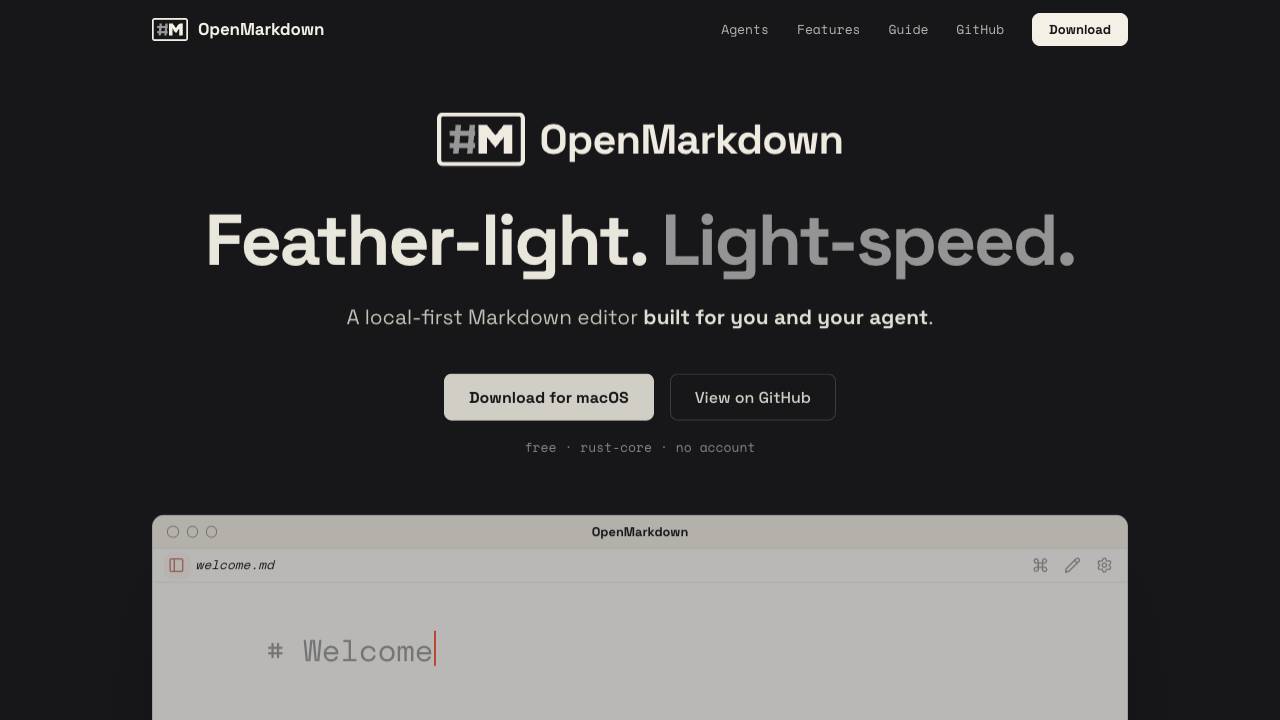
OpenMarkdown is a local-first Markdown editor for people who work with agents.
It opens plain .md files quickly, keeps them on disk, avoids accounts and telemetry, and connects to agents through a CLI, agent plugin, and MCP. The app itself does not include an AI model. Instead, it lets the user's existing agent read highlighted text, jump to relevant sections, and write back into the same file.
The launch framing is refreshingly specific: OpenMarkdown is not "AI notes." It is a Markdown editor designed for the moment when Markdown files are already shared memory between humans and tools.
What It Does#
OpenMarkdown combines a lightweight writing surface with agent-facing control points.
Based on the Product Hunt listing and official site, the product focuses on:
- Opening
.mdfiles quickly as a native macOS app. - Keeping files local, plain, and portable.
- Letting agents read selected text only when asked.
- Letting agents find and jump to the target section of a file.
- Supporting co-editing in the same document through CLI, plugin, and MCP workflows.
- Offering live preview, source, and reading modes in one editor.
- Supporting familiar command-palette and editor workflows.
- Avoiding accounts, telemetry, databases, and cloud sync as product dependencies.
The official site also positions OpenMarkdown as a bridge between existing agents and existing files. It mentions support for common agent environments and MCP clients, including Claude Code, ChatGPT Codex, Gemini CLI, GitHub Copilot, Cursor, opencode, and any MCP client.
The most interesting product choice is restraint. OpenMarkdown does not try to own the agent. It tries to own the local file experience around the agent.
Core Capabilities#
OpenMarkdown's feature set is clearest when viewed through the daily workflow of an agent-assisted builder.
- Fast file access: The site claims a sub-second cold start, with a 0.2-second click-to-window figure.
- Local-first storage: Notes remain ordinary
.mdfiles on disk, with no database or lock-in. - Agent-readable selection: A user can highlight text and ask an agent to rework it in place, without copying content into chat.
- Agent navigation: An agent can open the relevant file and jump to the relevant section instead of answering from a summary.
- Co-edit mode: A task-style command such as asking an agent to turn notes into a table can wake the agent, let it write back, then mark the task complete.
- Editor modes: One control cycles between live preview, source, and clean reading modes.
- Command palette: Users can jump to headings, find files, and run commands from the keyboard.
- Plain-text integrity: The site says OpenMarkdown does not reflow, trim, or reformat the file simply from opening and closing it.
- Privacy posture: The product is marketed as no account, no cloud, and no telemetry.
- Platform support: macOS is available now for Apple Silicon and Intel; Windows and Linux are marked as coming soon.
For developers and agent-heavy operators, the value is less about Markdown syntax itself and more about reducing friction between "I am writing" and "my agent should help inside this exact document."
Why It Matters#
Most AI writing workflows still introduce a context split.
The human writes in one place. The agent works in another. The user copies a section into chat, explains what file it came from, waits for a rewrite, copies the answer back, checks the formatting, and hopes the edit did not drift away from the surrounding context.
For small tasks, that is tolerable. For project memory, specs, task lists, launch notes, and working plans, it becomes a tax. The file is supposed to be the shared memory, but the collaboration loop keeps pulling work out of the file.
OpenMarkdown points at a cleaner model: let the agent operate where the text already lives.
That is especially relevant because agents increasingly depend on Markdown conventions. Repository instructions, implementation plans, checklists, product specs, and design docs are often just .md files. A specialized local editor can become the place where humans review, agents patch, and the file remains durable.
The product also pushes against the assumption that AI tools need to centralize everything. OpenMarkdown's local-first stance is practical. Many users do not want yet another cloud notebook, another account, another sync model, or another AI memory layer. They want their files to remain files.
Product Hunt Signal#
OpenMarkdown launched on Product Hunt in 2026 under Note and writing apps and AI notetakers, with launch tags for Productivity, Notes, and Developer Tools. At the time of verification on 2026-07-19, the page showed the product launching today, 201 followers, free pricing, a Product Hunt day rank of #5, and 184 points.
The maker post by XUEYANZ framed the product around two ideas: native agent read/write/co-edit, and instant peeking at Markdown files. The post also clarified an important positioning point: OpenMarkdown does not include built-in AI agents. The maker argues that this is intentional because users already work with project-specific agents, and OpenMarkdown's role is to connect those agents to the file the user is editing.
The comment thread was unusually useful because users pushed on the hard part: what happens when a human and an agent edit the same Markdown file at the same time.
The maker said OpenMarkdown does not use last-writer-wins for section-scoped agent writes. Instead, agent writes carry a hash of the section they read; if the user has changed that section, the agent write is rejected and the agent must re-read and retry.
Another question focused on agents that rewrite whole files through their own file tools, a common pattern in Claude Code and Cursor workflows. The maker replied that OpenMarkdown diffs the incoming file against the live buffer and applies the minimal changed ranges, so the editor avoids a full-buffer reload when the real change is smaller.
The thread also exposed a current limit. When an agent rewrite touches multiple sections, OpenMarkdown applies the resulting diff as one atomic undo entry today. The maker said per-section or more targeted undo is on the roadmap and expected in a next update.
That discussion is exactly the kind of launch signal that matters. Early users were not only applauding the concept. They were stress-testing cursor position, undo history, stale writes, whole-file rewrites, live preview, and concurrency boundaries.
What To Watch Carefully#
OpenMarkdown is aiming at a real workflow, but the product will be judged on details that are easy to underestimate.
First, co-editing has to feel calm under pressure. If an agent makes useful changes but the user's cursor jumps, undo history becomes confusing, or nearby edits feel fragile, the collaboration layer will lose trust quickly.
Second, conflict granularity matters. Section-level hashing is a sensible start, but large structural rewrites, list reflows, and edits around the user's active caret are still difficult. The maker has already acknowledged that finer block-level scoping may be needed.
Third, direct file writes are the messy path. MCP tools can constrain an agent to anchored section edits, but many agents still choose their own filesystem tools. OpenMarkdown's diffing layer is important because it has to handle the less disciplined path, not just the ideal integration path.
Fourth, platform availability is still narrow. OpenMarkdown is macOS-only today. That fits many agent-heavy builders, but broader adoption will need the promised Windows and Linux support.
Fifth, "local-first" still needs clear operational boundaries. No telemetry and no cloud are strong claims, but users will still want to understand how plugins, MCP tools, and agent permissions behave when external agents read and write local files.
Who Should Try It#
OpenMarkdown is most relevant for people who already live in Markdown and use agents as part of their daily workflow.
It may fit:
- Developers who keep project memory in
AGENTS.md,CLAUDE.md, specs, or task plans. - Claude Code, Codex, Cursor, Gemini CLI, Copilot, or MCP users who want agents to edit local Markdown directly.
- Writers and operators who use Markdown for planning, notes, checklists, and documentation.
- Teams that prefer plain files over cloud notebooks or proprietary document systems.
- Users who want a lightweight editor for quick
.mdpeeking and small corrections.
It is less compelling for users who want a full knowledge-base product with backlinks, databases, collaboration permissions, mobile sync, or built-in AI chat. OpenMarkdown is more focused than that. Its strength is the local file plus agent co-editing loop.
AIDeckly Take#
OpenMarkdown is interesting because it treats Markdown as agent infrastructure, not just a writing format.
That is the right lens. In agent-assisted work, Markdown files are no longer passive notes. They are instructions, memory, specs, prompts, checklists, and state. The better question is not whether an editor can generate text. It is whether the editor can let a human and an agent safely work on the same durable file.
OpenMarkdown's strongest idea is that the app should stay out of the model business. Let Claude Code, Codex, Cursor, Gemini CLI, Copilot, or any MCP client be the agent. OpenMarkdown becomes the fast, local, file-native surface where the collaboration actually lands.
The risk is that co-editing quality is unforgiving. A product like this can feel magical when cursor position, diffs, stale writes, and undo behavior work cleanly. It can also become irritating fast if those small mechanics are wrong. The Product Hunt thread suggests the maker understands the real pressure points, which is a good sign.
If OpenMarkdown can keep the editor light while making agent edits feel trustworthy, it could become a practical default for agent-era project memory: plain Markdown on disk, opened instantly, with the user's agent finally allowed onto the same page.
Sources#
- Product Hunt: https://www.producthunt.com/products/openmarkdown
- OpenMarkdown official site: https://openmarkdown.dev
- Product Hunt built-with page: https://www.producthunt.com/products/openmarkdown/built-with
- Product Hunt page content, launch metrics, maker post, and comment replies by XUEYANZ, verified on 2026-07-19