V2Fun: Turning Images, Prompts, and Video Into Usable 3D Assets
V2Fun: Turning Images, Prompts, and Video Into Usable 3D Assets#
 3D production has always had a strange bottleneck.
The creative idea can be simple: a game character, a virtual idol, a designer toy, a scene prop, or a product visualization. But turning that idea into a usable 3D asset usually means crossing several technical gates: concept art, modeling, mesh cleanup, UVs, textures, rigging, animation, export formats, and engine compatibility.
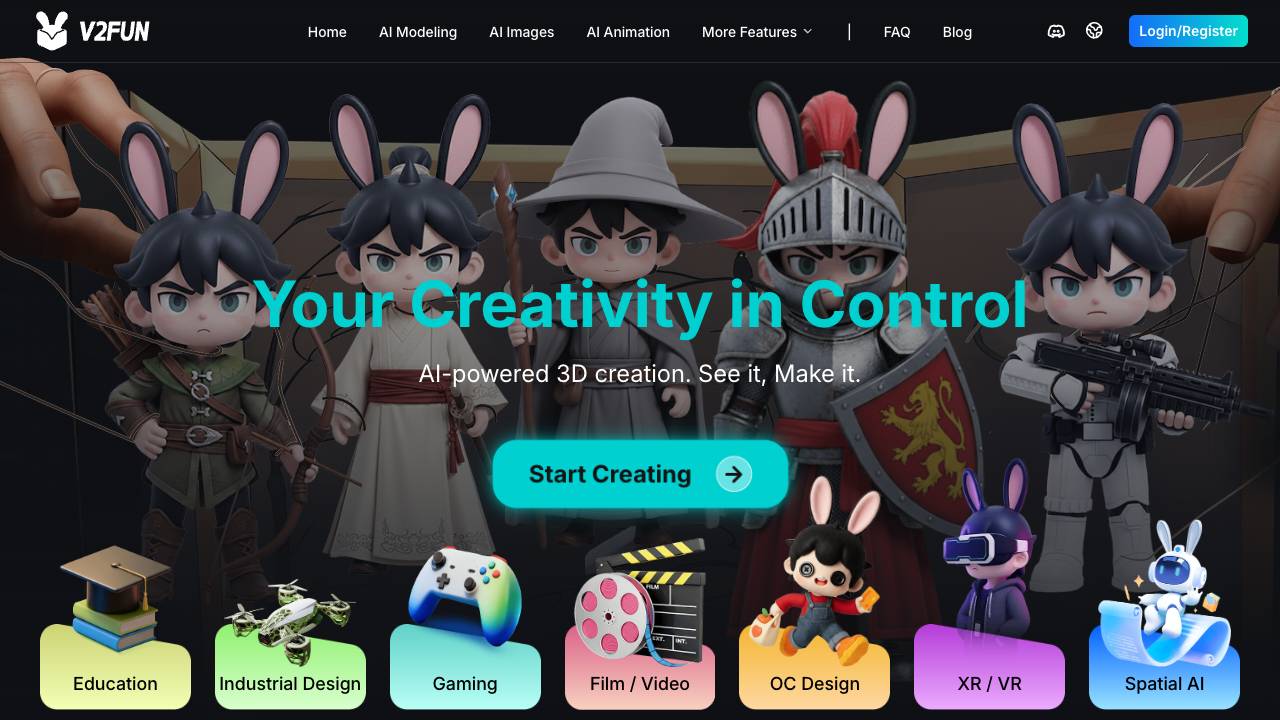
V2Fun is built around that gap. The product positions itself as an AI 3D model generator and broader AI 3D creation platform. Instead of treating 3D as one isolated generation step, it tries to connect the whole path from image or text prompt to model, texture, rig, motion, and export.
The Short Version#
V2Fun is like a browser-based 3D production pipeline for people who do not want to start in Blender or Maya.
Users can write a prompt or upload reference images, generate 3D models, improve prompts for spatial and material detail, add textures, rig characters, and animate them using motion libraries or video-driven motion capture.
That matters because many AI 3D tools stop at the first exciting output. V2Fun's bigger claim is that the output should keep moving downstream, toward games, virtual characters, film, 3D printing, and other production uses.
What It Does#
The official V2Fun site describes a workflow that combines several steps of 3D creation:
- Start with text-to-3D or image-to-3D input.
- Use built-in prompt optimization to enrich spatial perspective, PBR materials, and texture details.
- Generate 3D models from prompts or reference images.
- Create or change textures with AI material generation.
- Use AI automatic rigging to turn static T-pose models into animatable assets.
- Animate characters with a motion library, uploaded motion files, or AI motion capture from ordinary video.
- Export assets for downstream use, with the site referencing formats such as FBX and GLB in its texture workflow.
The important product idea is continuity. V2Fun is not only saying "make a 3D model from an image." It is saying "keep the asset usable after generation."
Core Capabilities#
V2Fun's feature set is aimed at the messy middle between concept and production.
The main capabilities include:
- AI image generation for 3D creation: Generate perspective-aware reference images that can feed the modeling process.
- Text-to-3D and image-to-3D generation: Create 3D assets from prompts or uploaded images.
- Multi-view image input: Upload front, side, and back references for more precise geometry.
- Smart retopology: Optimize meshes into cleaner, lighter, editable quad-mesh models.
- AI texture generation: Generate PBR-style materials, surface detail, lighting, bump detail, and roughness maps.
- AI automatic rigging: Detect keypoints and build a character skeleton, with room for manual calibration.
- AI animation and motion capture: Drive characters from motion libraries, motion files, or ordinary video.
This makes V2Fun more interesting than a single-purpose model generator. The product is trying to become the connective layer between visual imagination and usable 3D content.
Why It Matters#
The AI image generation wave made visual ideation dramatically faster. But 3D has been harder to compress because the output has to function, not just look plausible.
A static 2D image can be impressive even if it hides structural contradictions. A 3D asset cannot get away with that as easily. It has to hold up from different angles. It may need clean topology, consistent geometry, usable textures, a working skeleton, animation readiness, and export compatibility.
That is why V2Fun's all-in-one framing is meaningful. The problem for many creators is not only model generation. It is the handoff between each stage:
- Does the model preserve the concept's structure?
- Is the mesh clean enough for editing, animation, or game use?
- Can the asset be textured without manual UV pain?
- Can a character be rigged quickly enough to test motion?
- Can a creator export the result into a downstream workflow?
If AI 3D is going to move from demo to production, these are the questions that matter.
Use Cases#
V2Fun's official examples focus on three broad creator groups.
First, indie game developers and small teams. The product is positioned as a way to generate game-ready characters, scenes, props, and asset variants without needing a large 3D team.
Second, digital human and virtual idol creators. V2Fun emphasizes character animation, motion capture from ordinary video, and daily content production for VTubers, short-video IP, and virtual character workflows.
Third, 3D printing and custom creation. The site presents image-to-3D generation, structural fidelity, and standard export workflows as a way to move from concept art toward physical objects such as designer toys.
Across all three use cases, the value proposition is similar: reduce the cost and skill barrier of 3D production while keeping the output close enough to production needs that it can continue into the next tool or medium.
Product Hunt Signal#
V2Fun is listed on Product Hunt under 3D & Animation and AI Generative Media, with launch tags including Artificial Intelligence, 3D Modeling, and Animation. At the time of verification on 2026-07-16, the page showed 1K followers, free options, a #1 Day Rank, and 641 points.
The Product Hunt launch post gives useful context beyond the headline metrics. Tammy from the V2Fun team framed the product around a fragmented 3D workflow: creators often need separate tools for modeling, texturing, animation, and motion capture. The launch emphasized two new features in particular: 8K textures and AI motion capture from regular videos.
The comment thread also surfaced practical production questions. Makers said V2Fun can export rigged assets to FBX, GLB, OBJ, STL, USDZ, and BLEND for further editing in tools like Blender, Unity, and Unreal. They also clarified important limits: the product is not currently meant for manufacturing-ready CAD assets with precise real-world dimensions, direct 3D printing may still require cleanup or watertight checks, and motion capture is currently mainly optimized for humanoid character motion.
What To Watch Carefully#
V2Fun is aiming at a valuable problem, but AI 3D products need to be judged by more than first impressions.
First, geometry quality matters more than screenshot quality. A generated model can look good in a preview but still be painful to edit, rig, animate, print, or import into a game engine.
Second, character consistency is hard. The official site directly points to problems such as character drift and structural collapse in other AI tools. That is the right problem to target, but users should test whether V2Fun preserves identity, proportions, style, and details across multi-view inputs and revisions.
Third, downstream formats and licensing need careful review. Teams using generated assets in games, film, client projects, or products should verify export formats, texture maps, commercial usage rights, and any watermark or platform restrictions before building a workflow around the tool.
Fourth, automation should not hide craft judgment. Retopology, rigging, texture generation, and motion transfer are all useful accelerators, but professional-quality 3D work still depends on taste, cleanup, art direction, and technical review.
Who Should Try It#
V2Fun is most relevant for creators who need more than a pretty image but do not have the time, budget, or specialized skills to run a full 3D production pipeline.
It may fit:
- Indie game developers creating characters, props, and scene assets.
- Virtual character teams producing animated content more frequently.
- Designers and toy creators exploring 3D-printable concepts.
- Small studios that need rapid asset ideation before manual refinement.
- Creators who can describe or sketch an idea but do not want to begin with traditional modeling software.
It is less necessary if you already have a mature 3D team, strict topology standards, complex engine constraints, or a highly controlled art pipeline. In those cases, V2Fun may still be useful for ideation, but production adoption should start with a controlled asset test.
AIDeckly Take#
V2Fun is interesting because it treats AI 3D as a pipeline problem, not just a generation problem.
The first wave of AI visual tools trained users to expect instant images. But 3D creators need more than instant output. They need assets that can move, be edited, be textured, be rigged, be exported, and survive contact with real production constraints.
That makes V2Fun's direction sensible. By combining image generation, model generation, retopology, texture generation, rigging, animation, and motion capture into one browser-based workflow, it is chasing the practical part of AI 3D: less tool switching, fewer technical gates, and a shorter path from concept to usable asset.
The real test will be whether its generated assets are not only impressive on a landing page, but dependable inside the workflows that creators already use. If V2Fun can make that handoff reliable, it could become a useful bridge between imagination and production for the next generation of 3D creators.