Nitrosend: Email Infrastructure for Agents, Not Another Email Dashboard
Nitrosend: Email Infrastructure for Agents, Not Another Email Dashboard#
 Email software has spent years getting better at dashboards.
Campaign builders became cleaner, template editors became more visual, analytics became easier to read, and automation flows became more approachable. But the basic operating model stayed the same: a human logs in, configures the system, writes or approves the content, checks performance, and returns later to make changes.
Nitrosend is betting that model is starting to feel wrong.
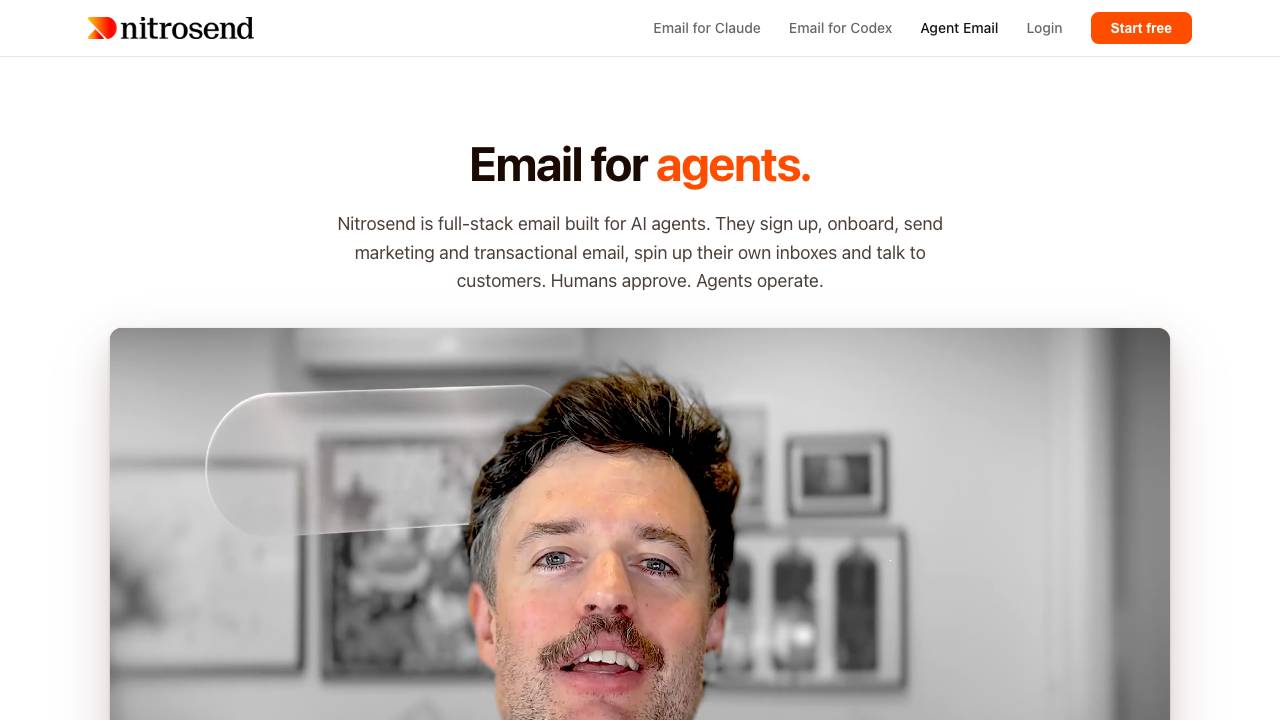
If teams are already working inside Claude, Codex, Cursor, ChatGPT, and other agentic environments, then email should not require a separate dashboard as the main control surface. Nitrosend frames itself as full-stack email for AI agents: the agent can read the product's skill file, sign up, connect a domain, send emails, manage campaigns, and eventually hold customer conversations through its own inbox.
That makes Nitrosend less like a conventional email marketing app with AI features attached, and more like an email layer designed for the agent economy.
The Short Version#
Nitrosend lets AI agents operate email workflows directly.
The product supports marketing email, transactional email, automation flows, brand kits, analytics, MCP/API/CLI access, and integrations with agent environments such as Claude, ChatGPT, Codex, Cursor, Gemini, and other MCP-compatible tools.
Its sharper launch angle is agent autonomy. Point an agent at nitrosend.com/SKILL.md, and the product says the agent can learn the platform, onboard itself, connect the domain, sort billing, and send its first email.
The newest piece is Agent Inboxes, currently in beta by request. These are real email addresses on a company's own domain, created for agents so they can send, receive, search, reply, and escalate 1-1 conversations.
Humans still approve. Agents operate.
What It Does#
Nitrosend combines several layers that are usually split across email platforms, APIs, and AI writing tools.
First, it provides full-stack email sending. The official site positions Nitrosend as one platform for transactional email, marketing campaigns, and automation flows. That means password resets, onboarding sequences, newsletters, product updates, and campaign emails can sit in the same agent-accessible workflow.
Second, it exposes email operations to agents through MCP, API, and CLI access. The product is not only saying "use AI to write an email." It is saying the AI environment should be able to operate the email system directly.
Third, it includes brand-aware generation. Nitrosend says it can create responsive, accessible, dark-mode-ready, on-brand email designs from natural-language prompts, using brand colors, fonts, logos, and audience context.
Fourth, it offers bring-your-own infrastructure on paid plans. Pro and above support bringing sending keys from providers such as SendGrid, Resend, Amazon SES, Mailgun, and Postmark, as well as AI provider keys from Anthropic and OpenAI.
Fifth, it is moving into agent identity. Agent Inboxes let a company create real addresses on its own domain for individual agents, so an agent can receive replies and participate in customer threads instead of only sending outbound messages.
This is the important distinction: Nitrosend is not just an email composer. It is trying to make email a native tool that an agent can buy, configure, run, learn from, and hand back to humans when needed.
Core Capabilities#
Nitrosend's current product surface is strongest around agent access, email execution, and governance.
- Agentic onboarding: An agent can read the Nitrosend skill file, create an account, connect a domain, configure setup, and send a first email.
- MCP/API/CLI access: All plans, including the free plan, include access to Nitrosend's agent-facing and developer-facing interfaces.
- Marketing and transactional email: The platform supports newsletters, flows, and transactional sends from the same system.
- Brand-aware email generation: Users can prompt for on-brand, production-ready email designs instead of manually dragging templates together.
- Brand and domain management: Each brand can keep its own domain, campaigns, audience context, and visual identity.
- Agent Inboxes: Beta inboxes let agents send and receive from real addresses on a company's own domain, while coexisting with Gmail, Outlook, or Zoho.
- Human approval gates: Bulk sends and sensitive actions can require human review, with draft-only safe mode available for teams that want zero autonomous sending.
- Deliverability guardrails: Maker replies on Product Hunt say sending is blocked until SPF, DKIM, and DMARC verify, fresh domains are quota-limited, and bounce and complaint monitoring run on sends.
- Pricing signal: The official pricing page lists a free plan, Pro at $20/month, Ultra at $100/month, and Enterprise starting at $300/month, with unlimited contacts and send-volume-based limits.
The shape is clear: Nitrosend wants to own the operational layer between an AI agent and the messy realities of email.
Why It Matters#
Email is one of the highest-leverage channels a company has, but it is also one of the least forgiving.
A bad internal draft can be deleted. A bad database query can be rolled back if the system is designed well. A bad email sent to thousands of customers is instantly public, brand-damaging, and sometimes legally sensitive.
That is why agentic email is a harder product category than agentic note-taking or task management. It sits at the intersection of customer communication, deliverability, consent, domain reputation, compliance, brand voice, and support escalation.
Nitrosend is interesting because it recognizes that agents need more than an email API. An API can send a message, but it does not automatically answer the bigger operational questions:
- Is the sending domain authenticated?
- Is this list opted in?
- Should this message be drafted or sent?
- Is this a transactional email or a marketing campaign?
- Should a human approve the final send?
- Is this reply routine enough for the agent, or sensitive enough to escalate?
- Is the agent hurting domain reputation?
If AI agents are going to run more commercial work, they need systems that encode these boundaries. Nitrosend's bet is that email should become an agent-native substrate with the right safety rails, not a legacy dashboard agents awkwardly drive from the outside.
Product Hunt Signal#
Nitrosend launched on Product Hunt in 2026 under Email clients, with visible launch tags for Email Marketing, Developer Tools, and Artificial Intelligence. At the time of verification on 2026-07-17, the page showed 155 followers, free options, a 3 Months Pro free offer, a Product Hunt day rank of #6, and 168 points.
The maker post gives useful background. George Hartley connected Nitrosend to his experience running Obooko, a free ebook platform with 840,000 readers on its list, through an AI agent. He also framed this as the team's third email company, after SmartrMail and Sendicate, with six billion emails sent between them.
The launch emphasized a progression:
- Shipped: agentic signup and onboarding.
- Live: headless newsletters, flows, and transactional email.
- Beta by request: Agent Inboxes on a company's own domain.
- Coming soon: agentic outreach where an agent researches prospects, writes personalized messages, handles replies, and escalates important threads.
- In development: goal-based agentic marketing.
The comment thread surfaced exactly the concerns that matter for this category.
Users asked whether an email is visibly agentic to recipients, how GDPR and opt-outs work, whether agents could damage deliverability on fresh domains, how privacy is handled for AI-managed conversations, what prevents agent spam, and when an agent inbox decides to escalate instead of replying itself.
The maker replies were practical rather than vague. George said emails are standard messages from the configured domain address, not visibly labeled as agentic by default. He said unsubscribe and opt-out are on by default, contact data does not train models, access is scoped per brand through MCP or API keys, and approval gates are on by default for list sends. On deliverability, he said SPF, DKIM, and DMARC must verify before sending, fresh domains cannot send at full volume immediately, and bounce and complaint monitoring are active.
The most revealing answer was about escalation. For Agent Inboxes, the team says users define what the agent owns, while money, cancellations, legal issues, upset customers, or ambiguous cases should be handed to humans. That is a sensible posture for a beta feature. It also shows why this product category is difficult: the hard part is not sending email. It is knowing when not to.
What To Watch Carefully#
Nitrosend is pointing at a real shift, but agentic email needs unusually careful evaluation.
First, deliverability is the product, not a side feature. If an agent can send from a company's real domain, SPF, DKIM, DMARC, warmup, quotas, bounce handling, complaint monitoring, stream separation, and reputation management all become core trust infrastructure. Buyers should test these controls before allowing meaningful autonomy.
Second, human approval needs to be configurable and hard to bypass. Approval gates are valuable only if teams can clearly define when an agent may draft, when it may send, and who can change those rules. Bulk sends, outbound sequences, policy changes, and sensitive replies should all be treated as high-impact actions.
Third, agent inboxes raise a judgment problem. Routine customer replies are one thing. Refunds, cancellations, angry customers, legal language, billing disputes, account changes, and edge-case support issues are another. The product's escalation model will need to prove itself against real-world ambiguity.
Fourth, compliance cannot stop at unsubscribe links. GDPR, consent records, suppression lists, data retention, audit logs, regional rules, and customer data boundaries matter more when agents are reading and writing customer conversations.
Fifth, agentic outreach is powerful but reputationally risky. Personalized outbound run by agents could be useful if it is genuinely targeted, consent-aware, and respectful. It could also become low-quality automation at scale if incentives are wrong. Nitrosend's own guardrails will matter here.
Who Should Try It#
Nitrosend is most relevant for teams that already work inside AI coding or agent environments and want email to become part of that workflow.
It may fit:
- SaaS teams that need transactional email and lifecycle campaigns without living in a separate email dashboard.
- Agencies managing multiple brands, campaigns, and client email programs.
- Builders who use Claude, Codex, Cursor, ChatGPT, or MCP-compatible agents as their daily operating layer.
- Small teams that want agents to draft, prepare, analyze, and eventually operate parts of email with human approval.
- Companies experimenting with AI support, customer replies, or agent-owned inboxes on a controlled basis.
It is less appropriate for teams that only need a simple newsletter tool, have no interest in agent workflows, or operate in compliance-heavy environments where data controls must be reviewed in detail before any AI system touches customer communication.
For most teams, the right starting point is supervised: let the agent draft, configure, and prepare, while humans approve final sends. Autonomy can increase only after the system earns trust.
AIDeckly Take#
Nitrosend is interesting because it is not treating AI as a writing feature inside email software. It is treating email as an operating surface for AI agents.
That is a better thesis than "AI email templates." The future of agent software will not be limited by whether a model can write a competent subject line. It will be limited by whether agents can safely operate real business systems: domains, customer lists, campaigns, replies, permissions, compliance rules, and escalation paths.
Nitrosend's strongest idea is that the dashboard should become the fallback. The primary workflow should happen where the builder or operator already works: inside Claude, Codex, Cursor, ChatGPT, or another agentic environment.
The risk is equally clear. Email is not forgiving enough for casual autonomy. The product has to be excellent at deliverability, approvals, consent, scoping, auditability, and escalation. If those controls are weak, agentic email becomes brand risk with a prompt box.
The Product Hunt discussion suggests the team understands that tension. The launch did not only attract excitement about agents sending emails; it attracted questions about domain reputation, compliance, spam, privacy, and handoff judgment. Those are the right questions.
If Nitrosend can make the boring parts dependable, it could become an important piece of infrastructure for agent-run companies: not another place to log in, but the email layer that agents can operate without making humans nervous.